
The Hidden Tissue That's Limiting Your Movement After 50
Why Your Hips Feel Locked And It’s Not Your Muscles

A few weeks ago I was warming up before a leg session in the gym.
My hips felt locked and my quads wouldn’t release. Everything felt tight, even though I’d slept well and wasn’t particularly sore.
It probably wasn’t my muscles causing the tightness problem, it was likely my fascia.
After 50, connective tissue, fascia, tendons, and ligaments, ages faster than muscle does. You can build muscle relatively quickly. Connective tissue takes months to adapt. This mismatch is exactly why so many over-50 athletes get injured.
Most people have never heard of fascia. But it affects every single movement you make, and after 50, it becomes one of the biggest limiters in your movement.
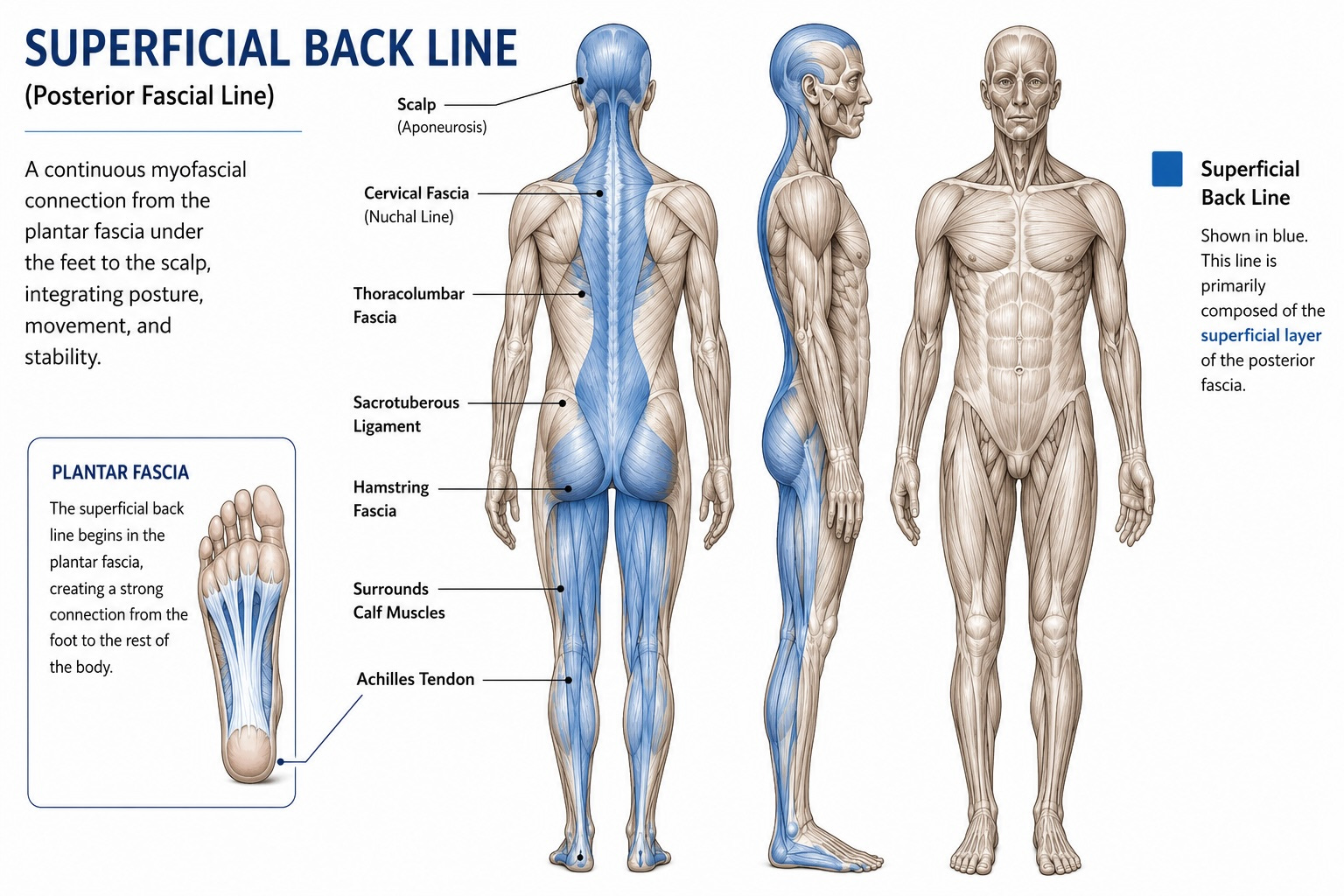
Think of it as a full-body wetsuit underneath your skin. It wraps around every muscle, bone, nerve, and organ in your body. One continuous web of connective tissue linking everything together.
When it’s healthy, it’s pliable and responsive. Force moves through it freely. You feel fluid.
Here’s what changes in your body:
Collagen production drops, meaning tendons and fascia lose tensile strength and elasticity. Tissue hydration decreases, making fascia stiffer and less pliable. Healing slows significantly, a tendon injury at 55 takes two to three times longer to resolve than at 30. Proprioception also declines as ligaments stiffen, reducing joint position awareness and increasing injury risk. And cold fascia at 55 is genuinely restrictive in a way it simply wasn’t at 35.
Research published in the Journal of Applied Physiology confirms that fascia is capable of changing its biomechanical properties, for better or worse depending on how you treat it. A study in the Journal of Anatomy found that older adults show significantly greater fascial thickness and stiffness than younger adults, with that thickness directly linked to reduced range of motion. Your muscles might be fine. The tissue wrapping them is the problem.
How to improve it.
Move every day. Fascia responds to movement. Even a 10-minute walk in the morning starts hydrating the tissue.
Take your warm-up seriously. Cold fascia at 55 is genuinely restrictive, not just uncomfortable. Give it 10 to 15 minutes to become pliable before you load it.
Use slow, sustained pressure. Foam rolling and targeted massage work, but only if you hold each spot for 60 to 90 seconds. Fast rolling does almost nothing.
Be consistent, not aggressive. Fascia adapts slowly. This is a months-long project, not a week-long fix.
Why hips are tight after 50.
The hip is surrounded by a dense network of fascial layers, the thoracolumbar fascia at the back, the iliotibial band on the outside, and the hip flexor fascia at the front. After years of sitting, training, and accumulated load, these layers thicken and lose their ability to slide freely against each other.
A 2020 study in Frontiers in Physiology confirmed that fascial tissue becomes measurably less elastic with age, reducing range of motion even in people who train regularly.
That morning stiffness you feel getting out of bed? That could be dehydrated, restricted fascia, not worn-out joints.
Stiff hips after 50 aren’t inevitable. But fixing them means working on the right tissue, not just stretching harder or pushing through it.
Stay Consistent
Rod
At 85, 20mins full body mobility moving every joint before I get out of bed starts my day.
I’m 54 and this explains why collagen as a supplement makes me feel better after a workout. It’s been the last year that its made a real difference. I’m warming up at least 10 minutes but sometimes I’m more impatient than others and when I take 15 minutes plus the workout feels better from the get go. I’ve had nagging injuries the last year that have been new. Nothing serious, but enough to make certain movements at heavier weights difficult. They are all getting better as I up my collagen intake and I am careful with movements.
As a side note, I’ve started using products with collagen for my skincare and seeing a huge difference there as well.